




In a milestone achievement for modern astronomy, NASA, ESA, and CSA announced on December 9, 2025 that the James Webb Space Telescope (JWST) has confirmed the earliest supernova ever observed: GRB 250314A. The blast originated 730 million years after the Big Bang, during the Epoch of Reionization, a period when the first stars and galaxies were transforming the universe’s foggy darkness into the transparent cosmos we see today.
The light from this explosion traveled 13 billion years to reach Earth. With a redshift of z = 7.3, GRB 250314A now holds the record for the farthest confirmed supernova, surpassing JWST’s prior record by more than a billion years. Even more remarkable: JWST was able to image the host galaxy, a feat never before achieved for a supernova at such a distance.
This discovery reshapes our understanding of early stellar life cycles, galaxy formation, and the cosmic environment that ultimately gave rise to the elements essential for planets and life.
What JWST found
The supernova behind GRB 250314A was the death of a massive star, likely 20–30 solar masses. Like other long-duration GRBs, the star collapsed into a compact remnant (likely a black hole), firing narrow jets that produced the initial gamma-ray flash.
Months later, radioactive nickel decay powered the supernova’s lingering glow, which JWST captured with unprecedented clarity. Spectral signatures of oxygen, silicon, and other heavier elements suggest that stars in this early era were more chemically enriched than theorists expected.

A tiny Galaxy with a big story
For the first time at z > 7, astronomers resolved the host galaxy of a supernova:
- Extremely faint (magnitude ~26)
- Low in metals
- Actively forming stars
- Structurally compact, typical of early starburst galaxies
These observations challenge longstanding assumptions that early galaxies were too primitive for such complex stellar life cycles.
Overcoming the challenges of the early universe
Detecting anything at z = 7.3 pushes the limits of astronomy. At this distance:
- Light is stretched deep into the infrared, invisible to ground-based telescopes
- The atmosphere hinders precise detection
- The afterglow fades quickly
JWST’s cryogenic mirrors, high-resolution infrared imaging, and rapid response made the discovery possible. From the initial alert to JWST’s capture, the global collaboration took just 3.5 months—a record pace for such distant events.
Why this matters
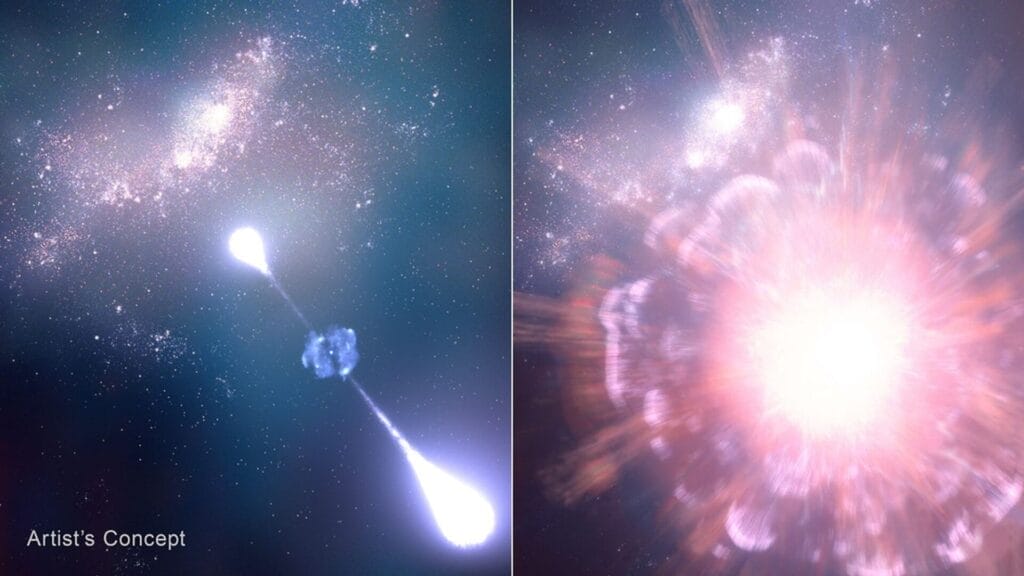
Artwork: NASA, ESA, CSA, STScI, Leah Hustak (STScI)
The discovery of GRB 250314A is more than a new record:

- Massive stars lived and died rapidly in the early universe within just a few million years.
- Their explosions seeded space with heavier elements, accelerating galaxy growth.
- GRBs serve as “cosmic lighthouses,” allowing astronomers to probe the faintest corners of the early cosmos.
- The supernova’s surprisingly “normal” profile indicates that stellar evolution matured earlier than many cosmological models predicted.
As researchers continue to sift through the data, this discovery will inform models of early star formation, galaxy growth, and chemical enrichment for years to come. And with each new observation, JWST pushes humanity further into the unknown, revealing a universe that was far more dynamic, complex, and active in its infancy than we ever imagined. GRB 250314A stands as a beacon from that ancient era, a reminder that even in the universe’s earliest chapters, the seeds of our cosmic story were already being written.


